Polypropylene
Lightweight and economical. A practical choice for many water-transfer, agricultural, and compatible chemical applications.
Best starting point: valueTell us what you’re connecting. We’ll show you the exact fitting type—and where to buy it.
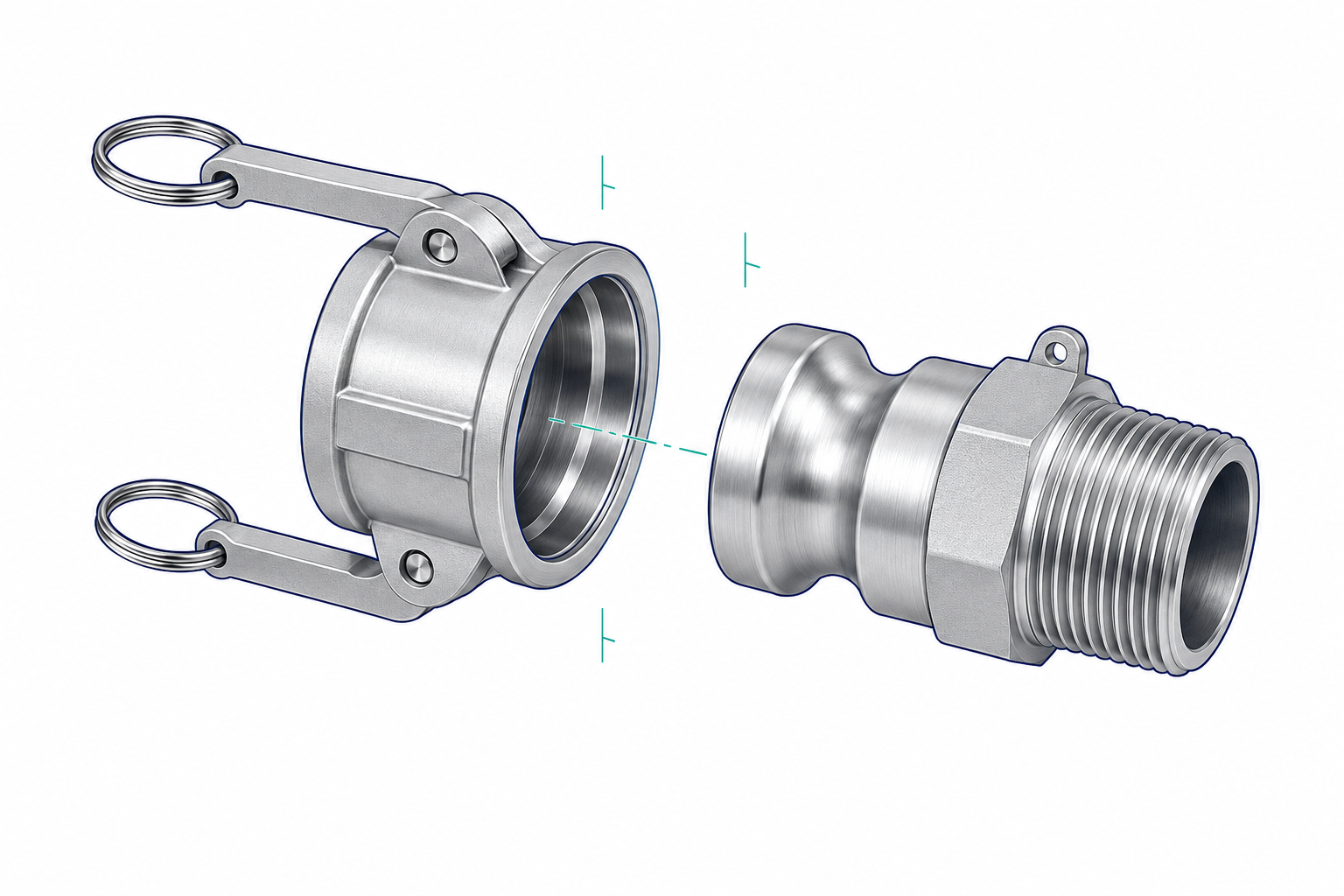
Choose the connection already on your hose, pipe, or equipment.
The letter identifies the two ends on a fitting. Start with the connection you have, then choose whether you need a female coupler or male adapter.
Male camlock adapter × female NPT thread
Shop this type →Female camlock coupler × male NPT thread
Shop this type →Female camlock coupler × hose shank
Shop this type →Female camlock coupler × female NPT thread
Shop this type →Male camlock adapter × hose shank
Shop this type →Male camlock adapter × male NPT thread
Shop this type →Female camlock dust cap
Shop this type →Male camlock dust plug
Shop this type →Couplers have arms. Adapters have the groove. Same-size couplers and adapters lock together.
Camlock sizes are nominal. A 2-inch camlock is selected for a 2-inch hose or 2-inch NPT connection even though its actual outside dimensions are different.
A 2" layflat hose normally takes a 2" Type C or Type E hose-shank fitting.
Measuring the male adapter’s outside diameter and treating that as the camlock size.
Material is a separate decision from fitting type. Confirm pressure, temperature, chemical, and gasket compatibility for the actual application.
Lightweight and economical. A practical choice for many water-transfer, agricultural, and compatible chemical applications.
Best starting point: valueDurable without excessive weight. Common for water transfer, pumps, irrigation, and general industrial service.
Best starting point: general useChosen when corrosion resistance, durability, cleanliness, or broader chemical compatibility matters.
Best starting point: demanding serviceThis guide helps identify connection geometry. Always verify the manufacturer’s pressure, temperature, media, and gasket ratings before putting a fitting into service.
Match the nominal size to the hose inside diameter or nominal NPT pipe size. Do not size the fitting by its outside diameter.
Yes. A male adapter and female coupler connect when both have the same nominal camlock size.
Check that the gasket is present, clean, undamaged, and compatible with the fluid. Make sure the adapter is fully seated and both arms are closed evenly.
Confirm that both sides use compatible NPT threads, inspect for damage, and use the appropriate thread sealant for the application.
Sometimes, but the whole assembly is limited by its least compatible material, gasket, pressure rating, and temperature rating. Verify the complete system.
DC is a female dust cap for a male adapter. DP is a male dust plug for a female coupler. They close unused ends; confirm whether they are rated for pressure in your application.
Shop poly, aluminum, and 316 stainless camlocks in the most-used sizes.